 Kinyarwanda
 English
 Swahili









Trump confronts the president of South Africa with a video and unfounded allegations of racism against white people
Cyril Ramaphosa, the president of South Africa, was ambushed by Donald Trump, who showed him a video that he claimed was proof that white people were being the victims of genocide under "the opposite of apartheid."

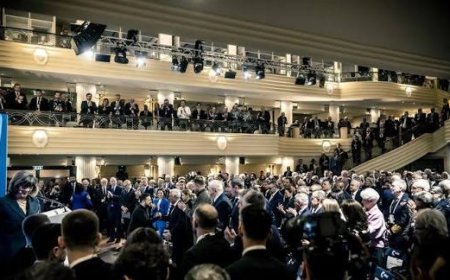
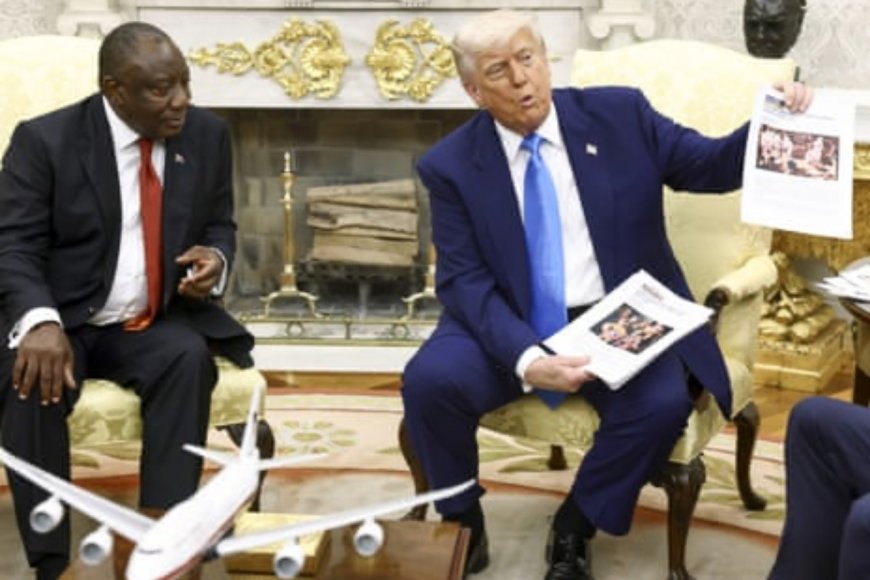
The most tense Oval Office interaction since Trump's intimidation of Volodymyr Zelenskyy in February was built up by the hectoring spectacle on Wednesday. However, Ramaphosa, who had previously stated that he had traveled to Washington in order to "reset" the two nations' relationship, declined to fall for the ploy and recommended that they "talk about it very calmly."
A group derived from mostly Dutch colonists who dominated South Africa throughout its decades of racial apartheid, Trump has long claimed that Afrikaners are being persecuted. The accusation is rejected by South Africa. The vast majority of victims are Black, and the nation has a high murder rate. Ramaphosa's statement to Trump that there is no genocide against Afrikaners abruptly changed the tone of what had started off as a friendly meeting at the White House, complete with lighthearted golf jokes. Trump commanded his staff to "turn the lights down and just put this on" after stating, "We have thousands of stories talking about it."
As Trump's billionaire ally Elon Musk, JD Vance, defense secretary Pete Hegseth, and diplomats and journalists from both nations watched, Ramaphosa, who was seated close to Trump in front of the fireplace, forced a smile and turned to face a large TV screen. As supporters danced, the film featured footage of former South African President Jacob Zuma and fiery opposition politician Julius Malema singing "Kill the Boer," a fight hymn from the apartheid era that translates to "farmer" or "Africaner." Quietly but firmly, Ramaphosa retorted that the opinions in the video are not official government policy.
There was also footage that Trump claimed showed the graves of more than a thousand white farmers, marked by white crosses. Ramaphosa, who had mostly sat expressionless, occasionally craning his neck to look, said he had not seen that before and would like to find out what the location was.
Trump then produced a batch of newspaper articles that he said were from the last few days reporting on killings in South Africa. He read some of the headlines and commented: “Death, death, death, horrible death.”
Ramaphosa acknowledged there is crime in South Africa and said the majority of victims were Black. Trump cut him off and said: “The farmers are not Black.”
The conspiracy theory of a white genocide has long been a staple of the racist far right, and in recent years has been amplified by Musk and rightwing media personality Tucker Carlson.
Trump kept returning to the theme during Wednesday’s televised meeting. He said: “Now I will say, apartheid: terrible. That was the biggest threat. That was reported all the time. This is sort of the opposite of apartheid.
“What’s happening now is never reported. Nobody knows about it. All we know is we’re being inundated with people, with white farmers from South Africa, and it’s a big problem.”
He added: “They’re white farmers, and they’re fleeing South Africa, and it’s a very sad thing to see. But I hope we can have an explanation of that, because I know you don’t want that.”
The meeting came days after about 50 Afrikaners arrived in the US to take up Trump’s offer of “refuge”. Trump made the offer despite the US having halted arrivals of asylum seekers from most of the rest of the world as he cracks down on immigration.
Relations between the countries are at their lowest point since the end of apartheid in 1994. The US has condemned South Africa’s case accusing Israel of genocide in Gaza at the international court of justice, slashed aid, announced 31% tariffs and expelled the South Africa ambassador for criticising Trump’s “Make America great again” (Maga) movement.
But the biggest bone of contention has been a South African land-expropriation law signed in January that aims to redress the historical inequalities of white-minority rule. Ramaphosa denied that the law will be used to arbitrarily confiscate white-owned land, insisting that all South Africans are protected by the constitution.
But Trump falsely asserted: “You do allow them to take land – and then when they take the land, they kill the white farmer, and when they kill the white farmer, nothing happens to them …
“You’re taking people’s land away from them and those people in many cases are being executed. They’re being executed and they happen to be white.”
NAACP President Derrick Johnson said of the meeting: “There’s no limit to how far Donald Trump will go to divide people on the basis of race. It’s frankly disgusting to hear the President of the United States — in the Oval Office — promote lies and propaganda. It’s shameful and appalling.”
Ramaphosa arrived at the White House with his agriculture minister, John Steenhuisen, who is white, two of South Africa’s top golfers, Ernie Els and Retief Goosen, and the country’s wealthiest person, Johann Rupert, in a bid to woo the golf-loving president. All weighed in during the Oval Office meeting and seemed to be well-received by Trump.
Rupert said South Africa needs technological help in stopping deaths in the country, which he said were not just of white farmers but across the board. “We have too many deaths … It’s not only white farmers, it’s across the board, and we need technological help. We need Starlink at every little police station. We need drones,” he said.
South Africa will reportedly offer Musk, who was born in the country, a deal to operate his Starlink satellite internet network in the country. The Tesla and SpaceX boss has accused Pretoria of “openly racist” laws, a reference to post-apartheid Black empowerment policies seen as a hurdle to the licensing of Starlink.
South Africa is one of the most unequal societies in the world. White people make up 7% of the country’s population but own at least half of South Africa’s land. They are also better off economically by almost every measure.
Away from the cameras, Trump and Ramaphosa held further talks and had a lunch where Musk was present. Later, at a press conference in a Washington hotel, Ramaphosa claimed the visit had been a success for trade and investment – and rejected Trump’s comparison with the apartheid era.
“There’s just no genocide in South Africa and of course it is an issue of how one looks at it,” he said. “As they say, sometimes the shape of the mountain depends on which point or direction you’re looking at it. In this case we cannot equate what is alleged to be genocide to what we went through in the struggle because people were killed, because of the oppression that was taking place in our country.”
But Ramaphosa suggested that Trump remains open to persuasion, telling reporters: “When he was asked by one of you - and thank God one of you asked - whether he was convinced that there was genocide, he says no, he’s not convinced. Much as he flighted the video and all those press clippings, in the end I do believe that there’s doubt and disbelief in his head about all this.”
Tags: