issa
The National Institute of Statistics of Rwanda announces 1.7% increase in national dietary energy supply

The National Institute of Statistics of Rwanda announces 1.7% increase in national dietary energy supply

Nov 26, 2025 - 07:32
 0

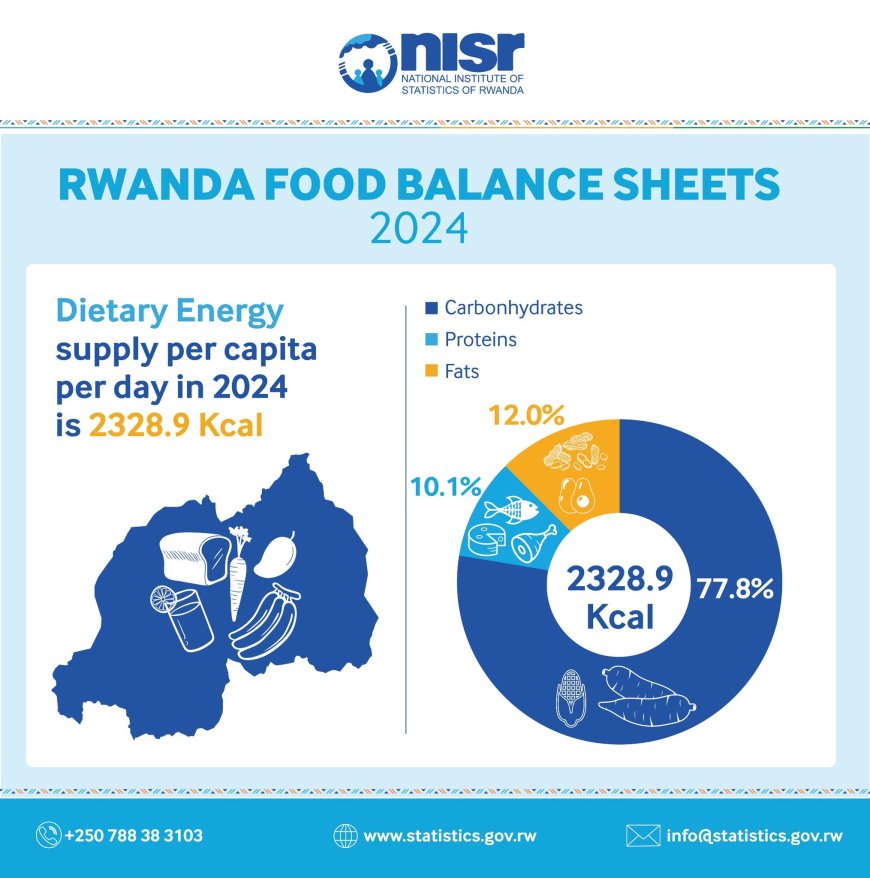
The National Institute of Statistics of Rwanda (NISR) has announced that the country’s Dietary Energy Supply (DES) increased by 1.7%, rising to 2,328.9 kilocalories per person per day in 2024, up from 2,289.6 kcal in 2023.


The report, drawn from the 2023–2024 Food Balance Sheets (FBS), highlights steady improvements in Rwanda’s food availability and nutritional supply.

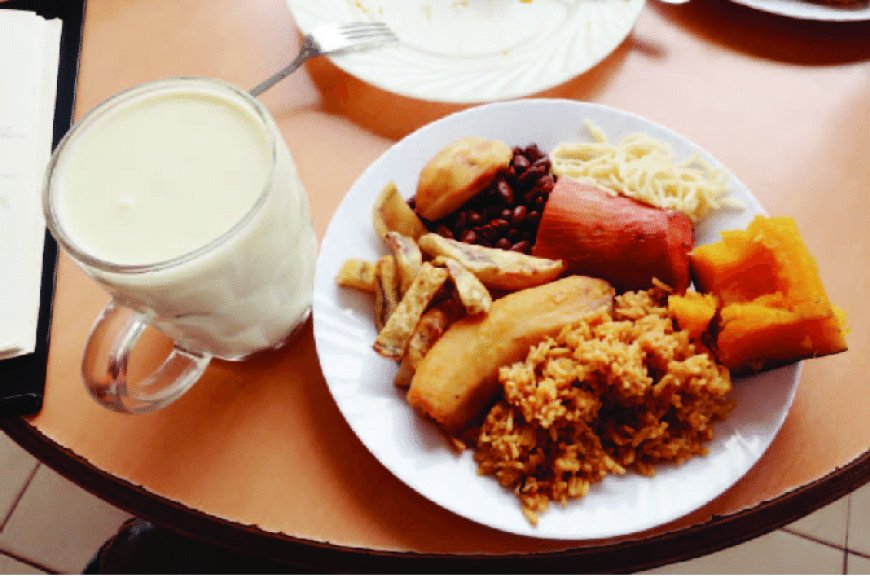
According to NISR, Rwanda’s diet continues to be overwhelmingly plant-based, with vegetal products contributing 2,289 kcal of the total DES, while animal-based foods accounted for only 40 kcal. The main energy sources were cereals (707 kcal), starchy roots (649 kcal), pulses (285 kcal), and fruits (190 kcal). Smaller contributions came from sugar, vegetable oils, vegetables, and milk, whereas meat, fish, eggs, and animal fats supplied minimal energy.

Nutrient availability per capita also improved. Protein intake rose to 59.1 grams per day (+1.9%), while fat intake reached 31.1 grams per day (+3.7%). Annual food supply trends further emphasized plant-based consumption, with starchy roots leading at 258.2 kg per person (43.3% of plant products), followed by fruits (99 kg) and cereals (87.3 kg).

Among animal-based foods, milk remained the largest contributor at 10.9 kg per person, reflecting a 28% increase compared to 2023. Meat (2.5 kg), eggs (0.2 kg), and animal fats (1.1 kg) saw slight declines.

The Food Self-Sufficiency Ratio (SSR) stood at 79% in 2024, slightly down from 80% in 2023, showing that domestic production continues to meet most national food needs, though imports remain necessary. The FBS also include the Import Dependency Ratio (IDR), Food Loss Index (FLI), and Prevalence of Undernourishment (PoU), offering a fuller perspective on Rwanda’s food security and nutrition status.

NISR emphasizes that these Food Balance Sheets provide essential evidence for policymakers, researchers, and development partners, supporting planning and strategies for food security, nutrition, and sustainable agriculture.
The National Institute of Statistics of Rwanda announces 1.7% increase in national dietary energy supply

Nov 26, 2025 - 07:32
 0
The National Institute of Statistics of Rwanda announces 1.7% increase in national dietary energy supply

The National Institute of Statistics of Rwanda (NISR) has announced that the country’s Dietary Energy Supply (DES) increased by 1.7%, rising to 2,328.9 kilocalories per person per day in 2024, up from 2,289.6 kcal in 2023.


The report, drawn from the 2023–2024 Food Balance Sheets (FBS), highlights steady improvements in Rwanda’s food availability and nutritional supply.

According to NISR, Rwanda’s diet continues to be overwhelmingly plant-based, with vegetal products contributing 2,289 kcal of the total DES, while animal-based foods accounted for only 40 kcal. The main energy sources were cereals (707 kcal), starchy roots (649 kcal), pulses (285 kcal), and fruits (190 kcal). Smaller contributions came from sugar, vegetable oils, vegetables, and milk, whereas meat, fish, eggs, and animal fats supplied minimal energy.

Nutrient availability per capita also improved. Protein intake rose to 59.1 grams per day (+1.9%), while fat intake reached 31.1 grams per day (+3.7%). Annual food supply trends further emphasized plant-based consumption, with starchy roots leading at 258.2 kg per person (43.3% of plant products), followed by fruits (99 kg) and cereals (87.3 kg).

Among animal-based foods, milk remained the largest contributor at 10.9 kg per person, reflecting a 28% increase compared to 2023. Meat (2.5 kg), eggs (0.2 kg), and animal fats (1.1 kg) saw slight declines.

The Food Self-Sufficiency Ratio (SSR) stood at 79% in 2024, slightly down from 80% in 2023, showing that domestic production continues to meet most national food needs, though imports remain necessary. The FBS also include the Import Dependency Ratio (IDR), Food Loss Index (FLI), and Prevalence of Undernourishment (PoU), offering a fuller perspective on Rwanda’s food security and nutrition status.

NISR emphasizes that these Food Balance Sheets provide essential evidence for policymakers, researchers, and development partners, supporting planning and strategies for food security, nutrition, and sustainable agriculture.